
Tender response prepared, checked, ready to sign
Upload the tender. Download the submission.
Generate high-quality bids and tender proposals, and cut more than 90 percent of your effort and preparation time.Complete more bids, faster, and give each one a better chance of being selected.
Tenderrizer reads every file an issuer sends, works out what is demanded of you, checks your company against it and prepares the whole response: proposals, method statements, compliance schedules, declarations, and the issuer's own forms filled in place. Your team reviews and signs. A week of bid work becomes an afternoon.
One Malaysian government-linked tender, taken from the issuer's documents to a reviewed submission pack.
00 The tour
One real government tender, start to finish, explained in 90 seconds.
The files the issuer sent, the plan, the documents, the adjustments and the pack, as they appear in the product.
01 How it works
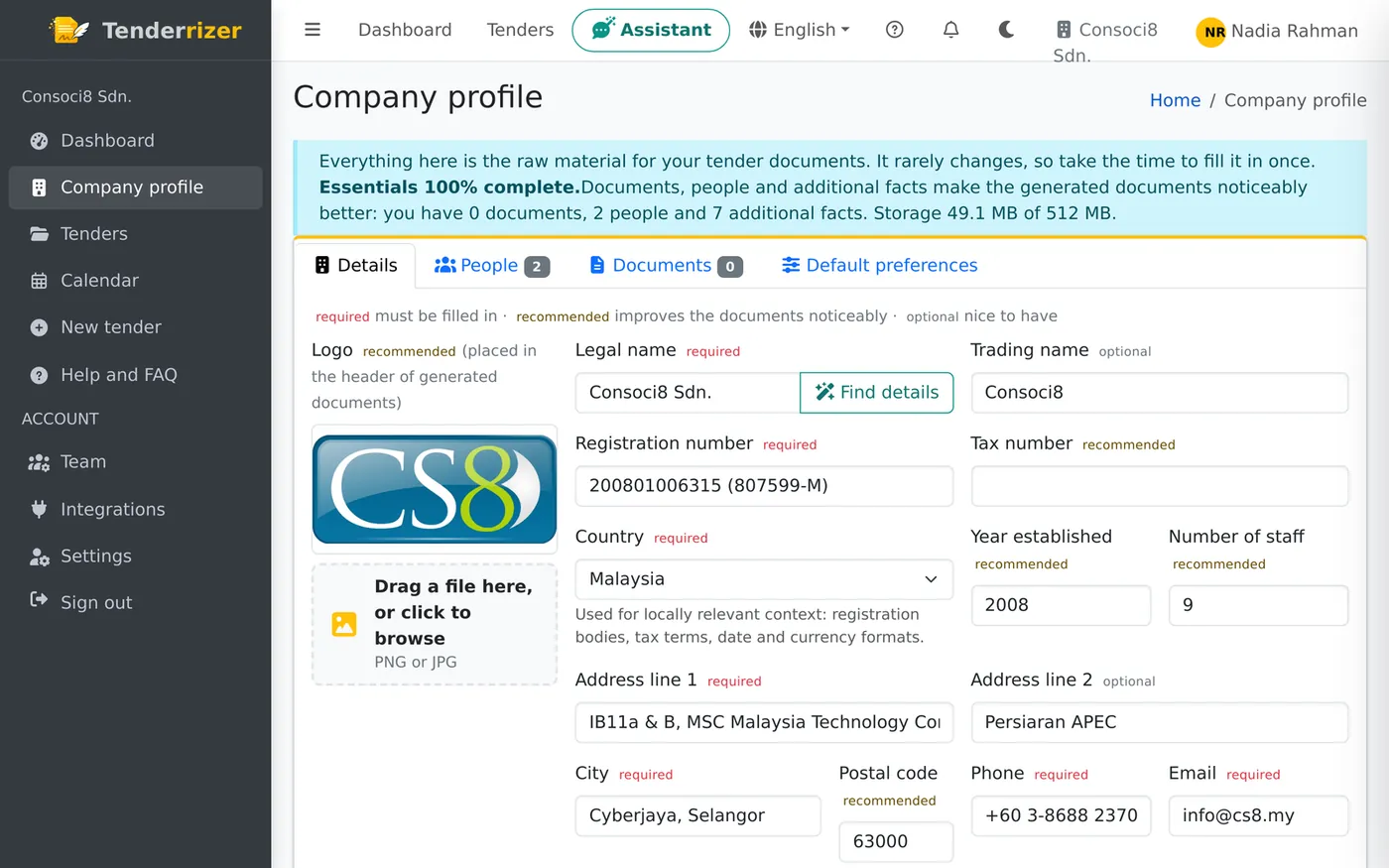
You describe your company once. Every tender after that starts half written.
Six steps, and a person decides at each one that matters. Nothing is written until your team has approved the plan, and nothing leaves the building until they have read it.
-
Registration, directors and key staff with their CVs, certificates, past projects and financials. Every document quotes it wherever a tender asks for the same facts, so nobody types the registration number into fifty places again.
-
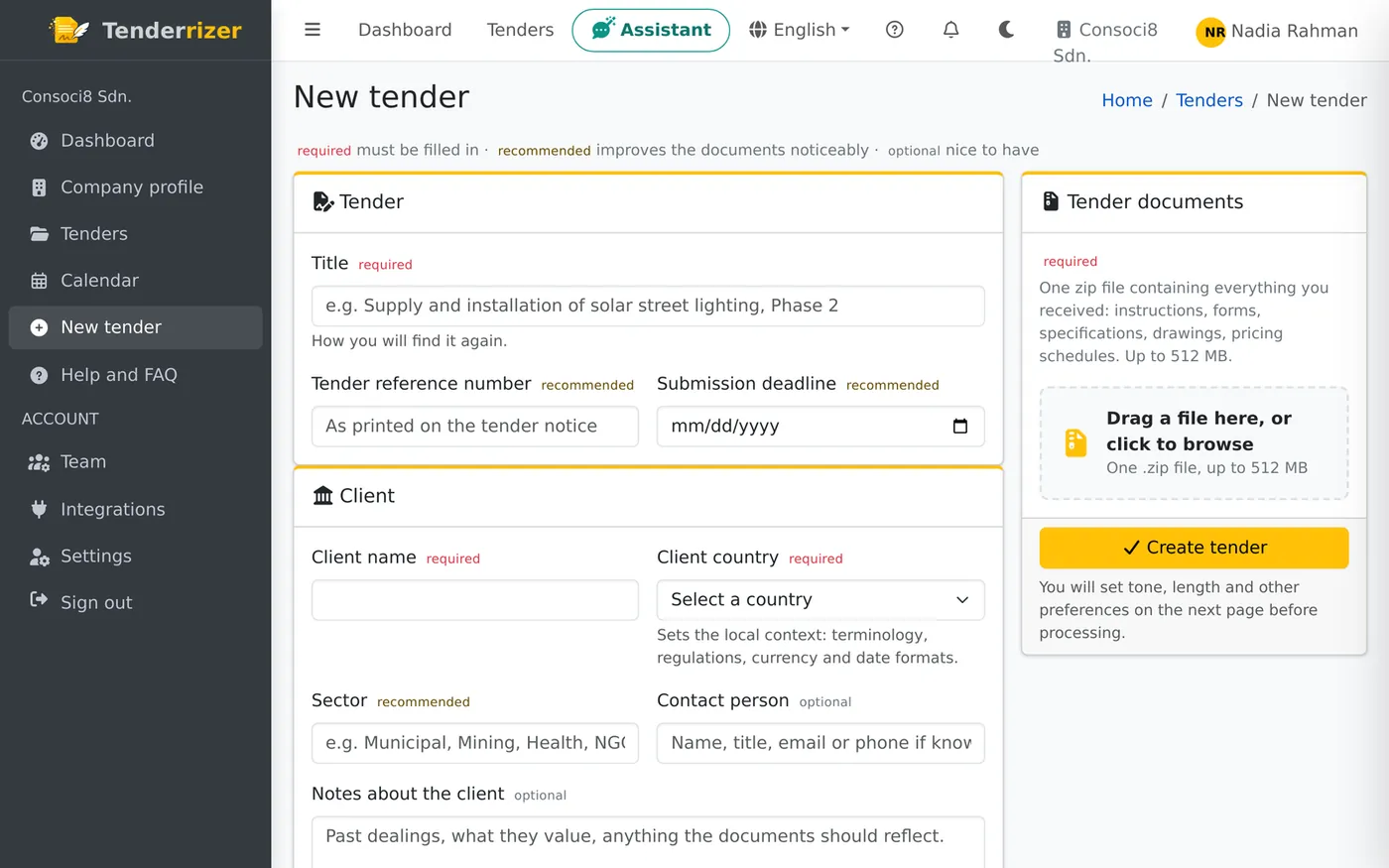
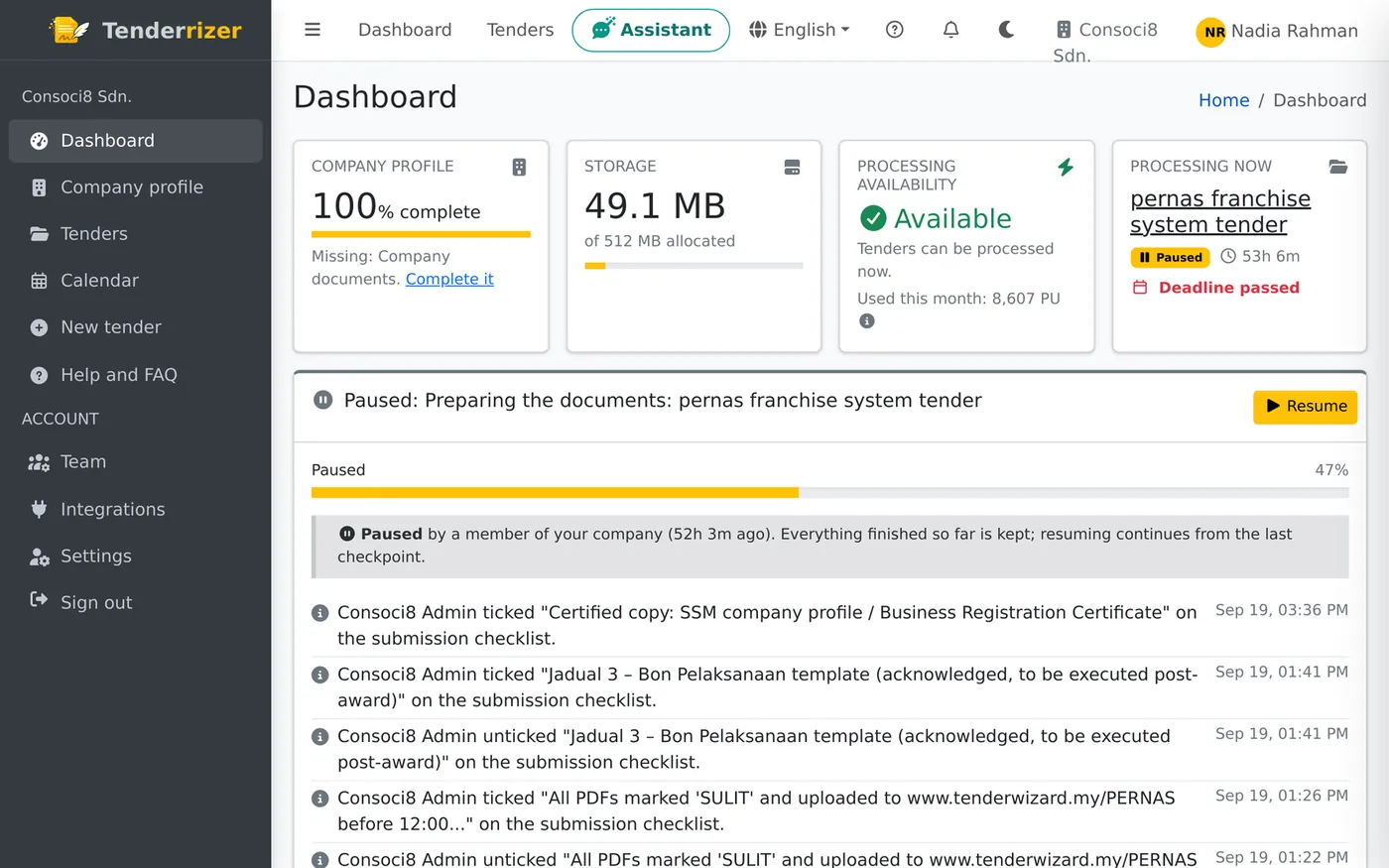
The zip as it came: PDFs, Word, Excel including macro workbooks, drawings and scanned pages, which are read by OCR. State the client, the deadline and the price you intend to bid.
-
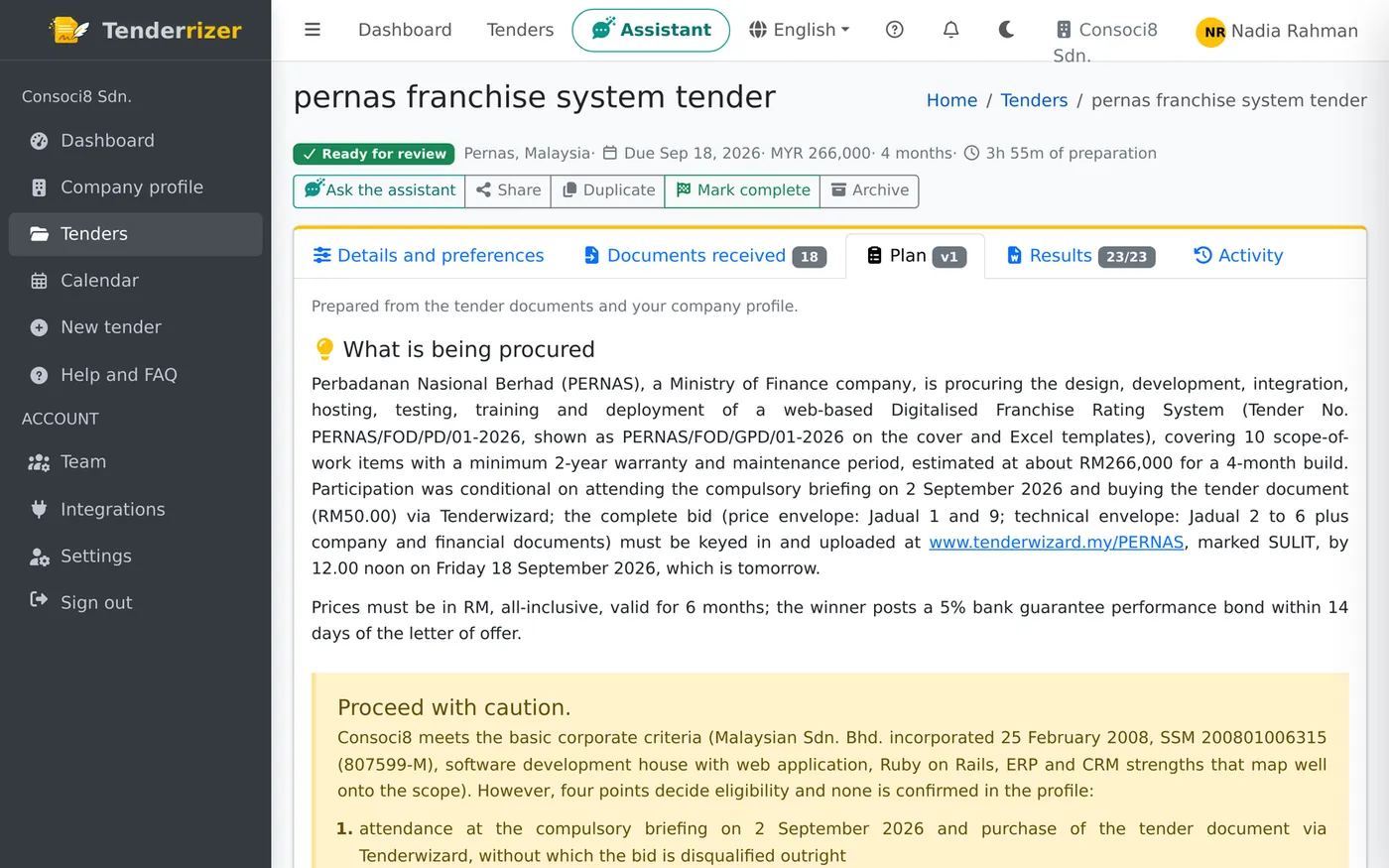
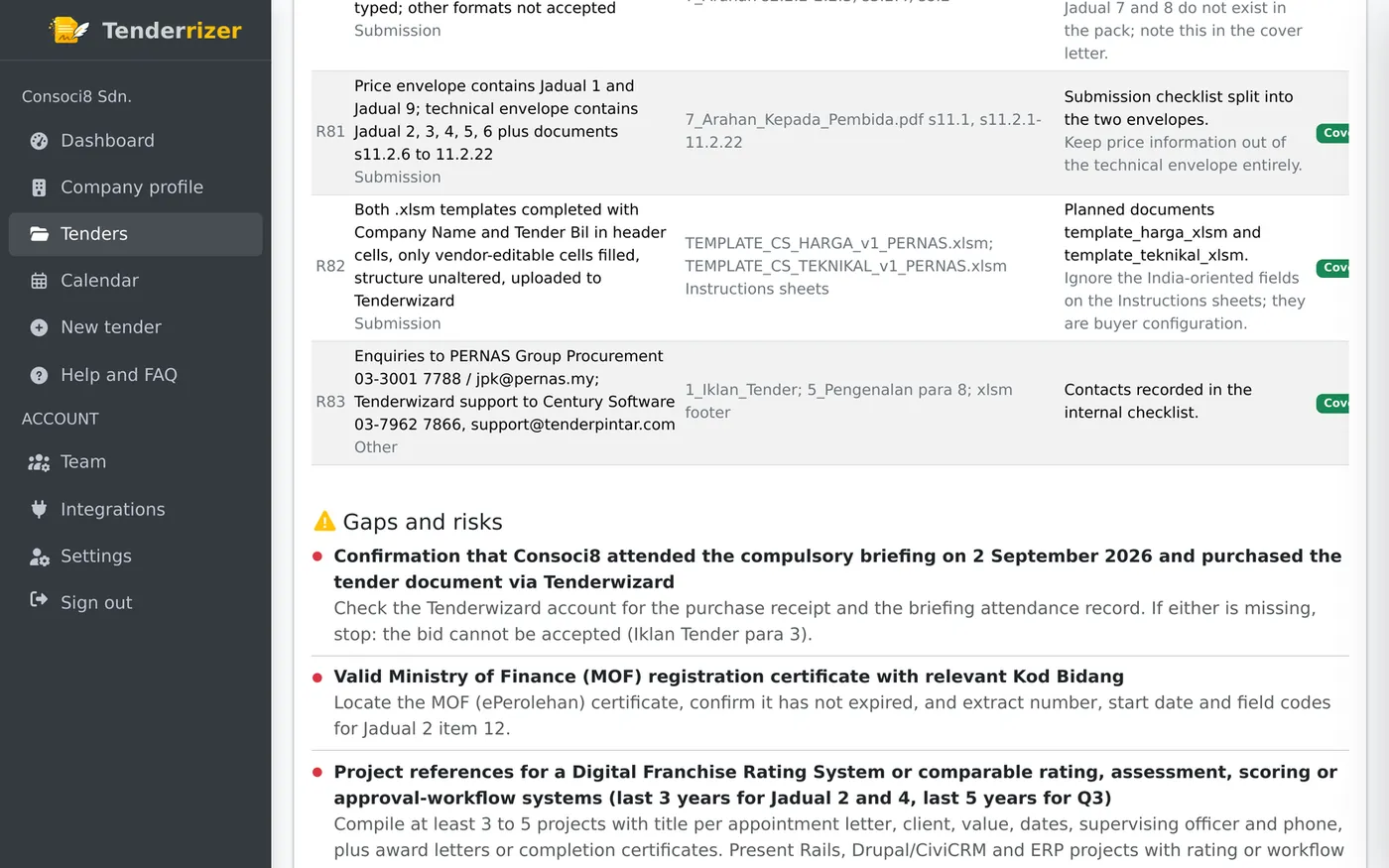
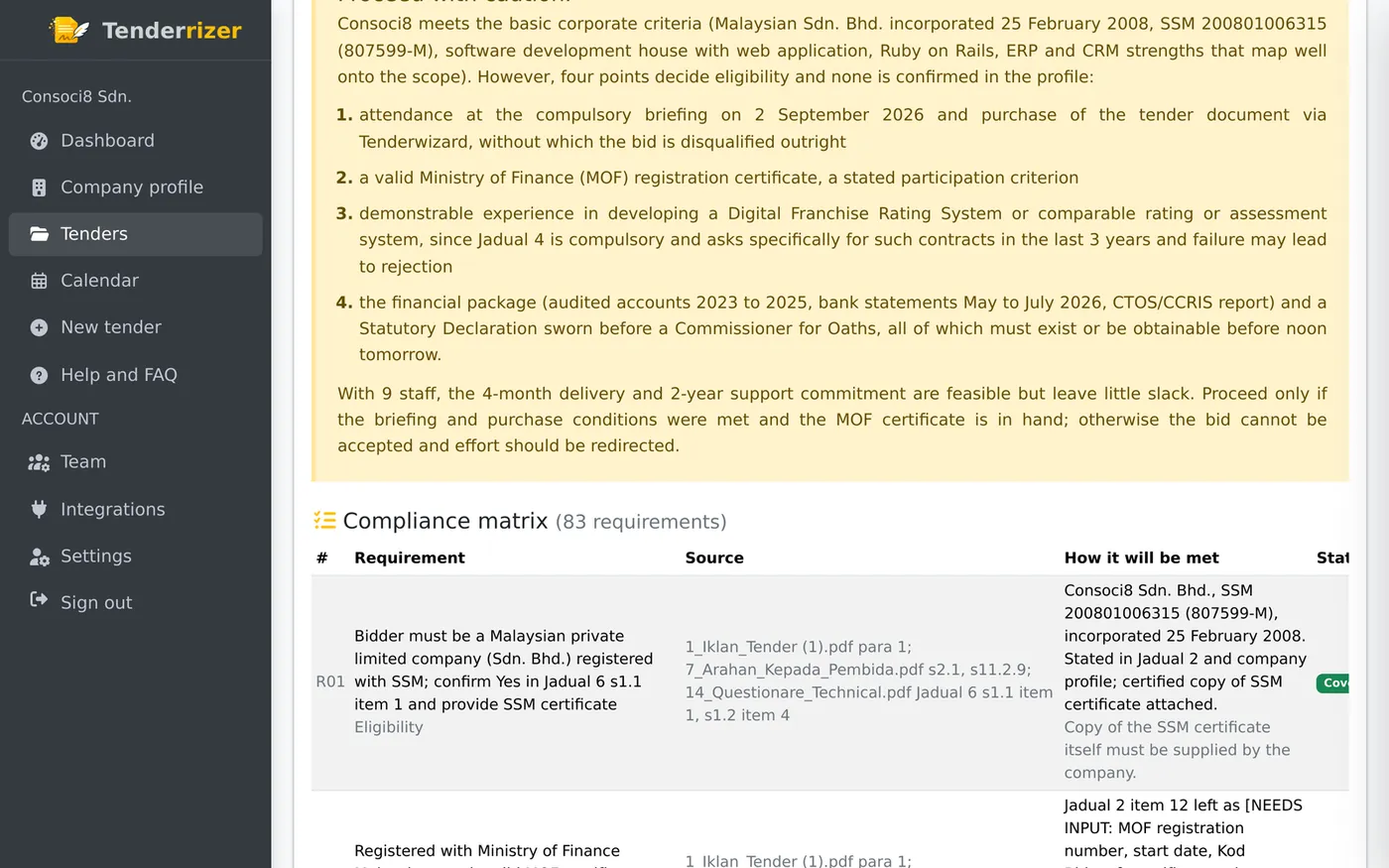
Every requirement is extracted with the clause it came from and set against your profile. You get a go / no-go, a compliance matrix, gaps and risks, questions for you and for the issuer, the list of documents to prepare and the envelope each belongs in.
-
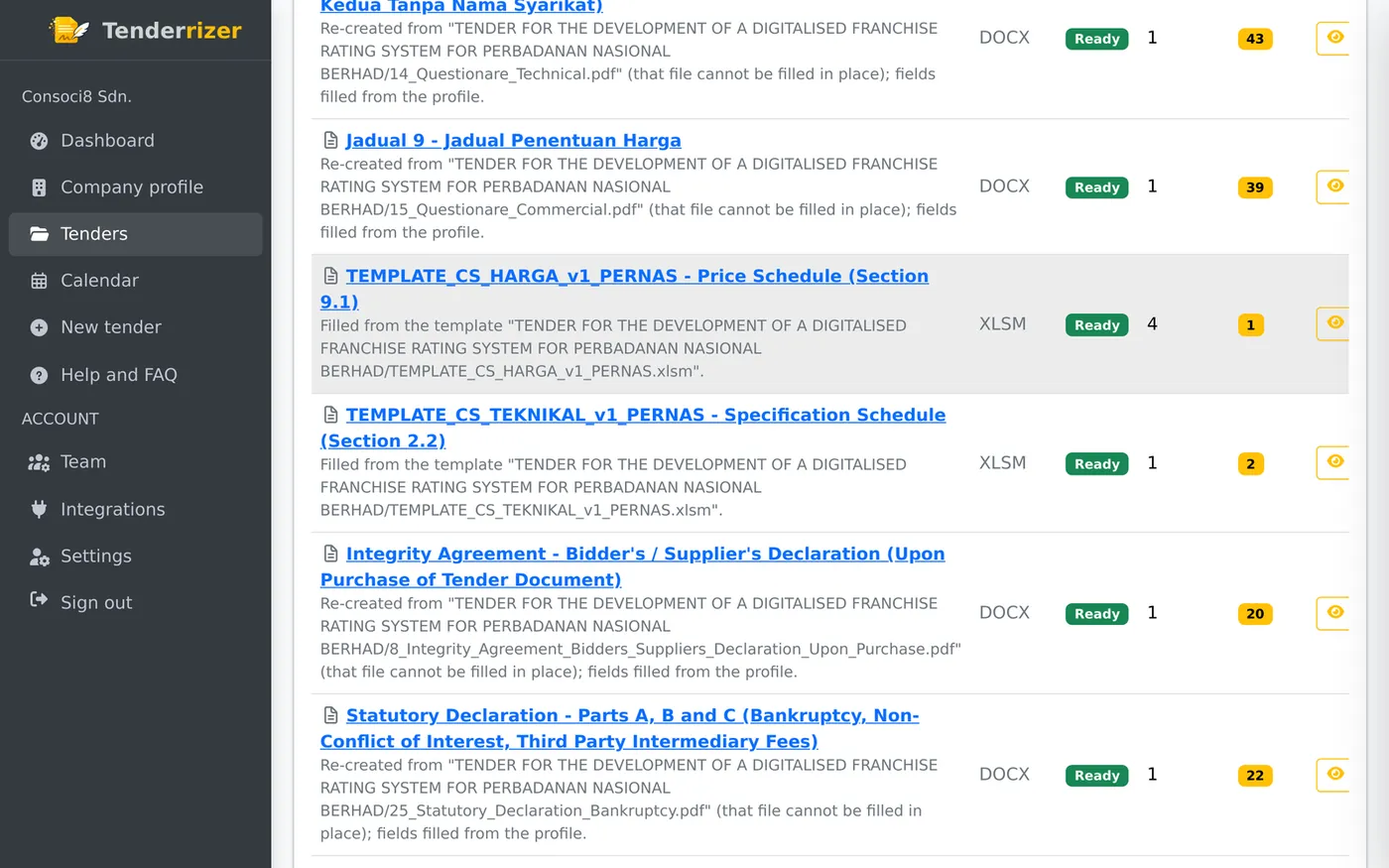
Free-form documents are drafted section by section against the requirements. The issuer's Word and Excel forms are filled in place with their layout untouched; forms that cannot be filled, such as PDFs, are mirrored so the answers can be copied across. One pricing basis feeds every schedule.
-
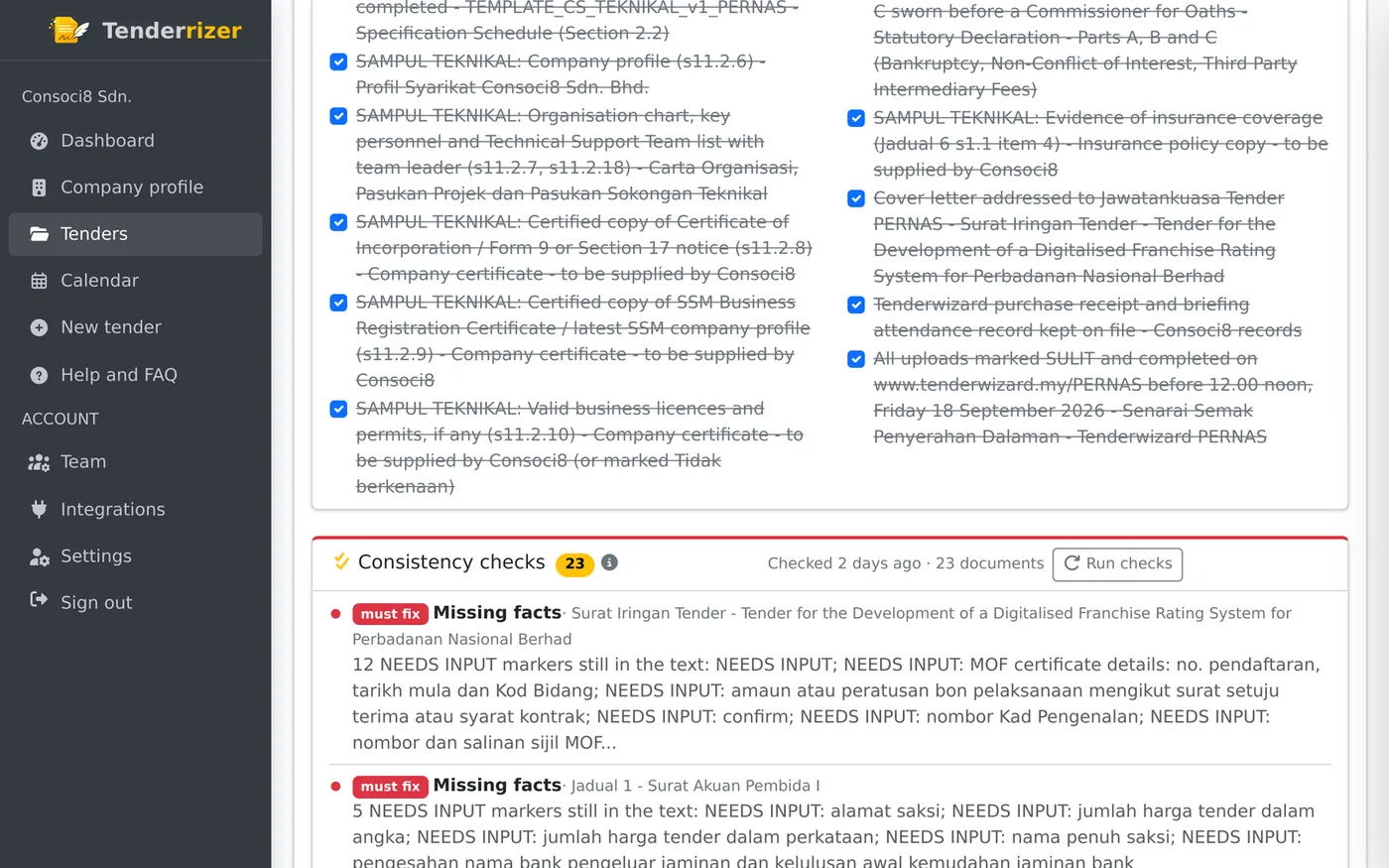
Names, registration numbers, references and totals are compared across every document. Anything the system could not confirm is marked NEEDS INPUT instead of being made up, and a scorecard reads the pack the way an evaluator would.
-
Read every document in the browser, edit it, or ask for an adjustment in plain words, to one document or to all. Download the pack by envelope, and keep a record of exactly what was sent and how the bid ended.
02 Across borders
Every country tenders differently. The rule you missed is the one that disqualifies you.
A tender rarely spells out everything it expects. Tenderrizer keeps a knowledge base of 203 entries across 51 countries, and reads the part that fits the issuer's country and your industry before it plans a single document. It tells you what the documents only hint at.
What the knowledge base covers, country by country
Countries with deep local knowledge in our Tenderrizer engine
- Australia
- Austria
- Bahrain
- Belgium
- Brunei
- Bulgaria
- Cambodia
- Canada
- Croatia
- Cyprus
- Czechia
- Denmark
- Estonia
- Finland
- France
- Germany
- Greece
- Hungary
- India
- Indonesia
- Ireland
- Italy
- Kenya
- Kuwait
- Laos
- Latvia
- Lithuania
- Luxembourg
- Malaysia
- Malta
- Myanmar
- Netherlands
- Nigeria
- Oman
- Philippines
- Poland
- Portugal
- Qatar
- Romania
- Saudi Arabia
- Singapore
- Slovakia
- Slovenia
- South Africa
- Spain
- Sweden
- Thailand
- United Arab Emirates
- United Kingdom
- United States
- Vietnam
Your country not on the list? We can still prepare your tender.
Tenderrizer reads tenders from any country, in their own language, and applies international procurement practice to them. The countries above are where it also brings a deep, reviewed knowledge base of local registrations, tax, procurement law and how bids are evaluated. It learns with every tender it handles: the engine proposes additions, and the Tenderrizer team reviews each one before it is used.
Ask us about your country →Registrations the issuer checks
Ministry of Finance supplier registration and field codes, CIDB contractor grades, LHDN and SST identifiers, and the bilingual format of Malaysian tenders.
Local content and platforms
Etimad and the Government Tenders and Procurement Law in Saudi Arabia, local content schemes, trade licences and contractor classification in the Emirates.
The evidence behind the form
The ESPD and the evidence asked for at award, most economically advantageous tender scoring, the Procurement Act 2023 and Find a Tender.
A tender by any other name
Some issuers call it a tender. Others call it a bid, a contract, a solicitation, a call for competition or a procurement. Whatever the name on the cover, it is the same job: documents that ask what you offer, and a deadline to answer by. Tenderrizer reads them all.
| Where | What the issuer calls it | In the local language |
|---|---|---|
| United Kingdom, Ireland, the Commonwealth | Tender, invitation to tender (ITT), contract notice, selection questionnaire | |
| United States | Solicitation, contract opportunity, request for proposal (RFP), invitation for bid (IFB), request for quotation (RFQ) | |
| European Union | Call for tenders, contract notice, public contract | appel d'offres, Ausschreibung, licitación, gara d'appalto, aanbesteding |
| World Bank and development banks | Request for bids (RFB), request for proposals, expression of interest (EOI) | |
| Malaysia | Tender, quotation, procurement | tender, sebut harga, perolehan |
| Indonesia | Tender, procurement of goods and services | tender, lelang, pengadaan barang/jasa |
| Saudi Arabia and the Gulf | Competition, tender | منافسة، مناقصة |
| France and francophone Africa | Call for tenders, public contract, consultation | appel d'offres, marché public, consultation |
| Russia and neighbouring countries | Tender, procurement, competition, auction, request for quotations | тендер, закупка, конкурс, аукцион, запрос котировок |
| China | Invitation to bid, bid, government procurement | 招标, 投标, 政府采购 |
| Japan and Korea | Bidding | 入札, 입찰 |
| India | Tender, e-tender, notice inviting tender (NIT), GeM bid | |
| Australia | Request for tender (RFT), approach to market | |
| Companies buying for themselves | Request for proposal, request for information (RFI), prequalification, vendor registration |
In the tender's own language
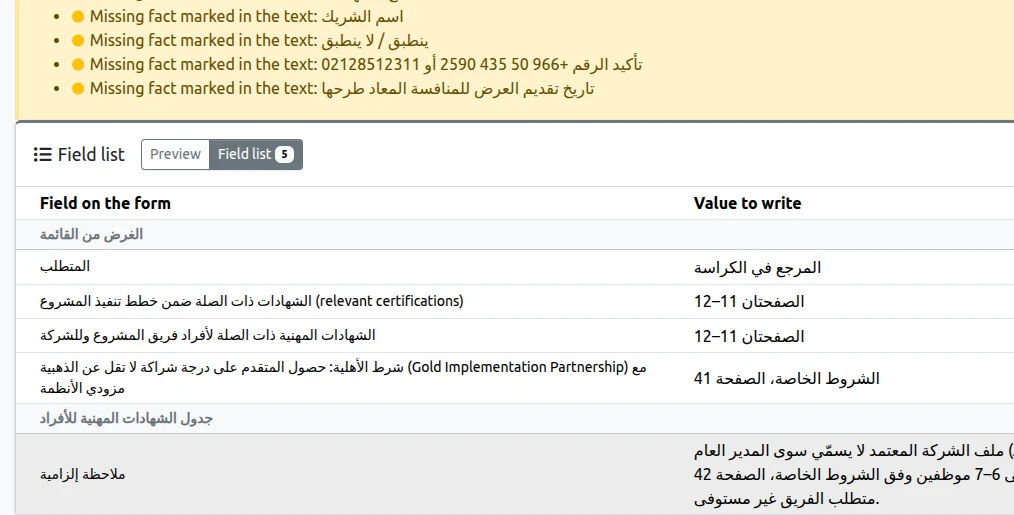
Arabic, Malay, French or English: each document is written in the language of the part of the tender it answers, keeps the issuer's own terms, and fills the issuer's forms in the language they were issued in. The interface itself runs in nine languages.
Whatever the language, the same rules apply: every field is traced, and every fact the company has not yet given is listed before anything is written into the form.
03 Tender search
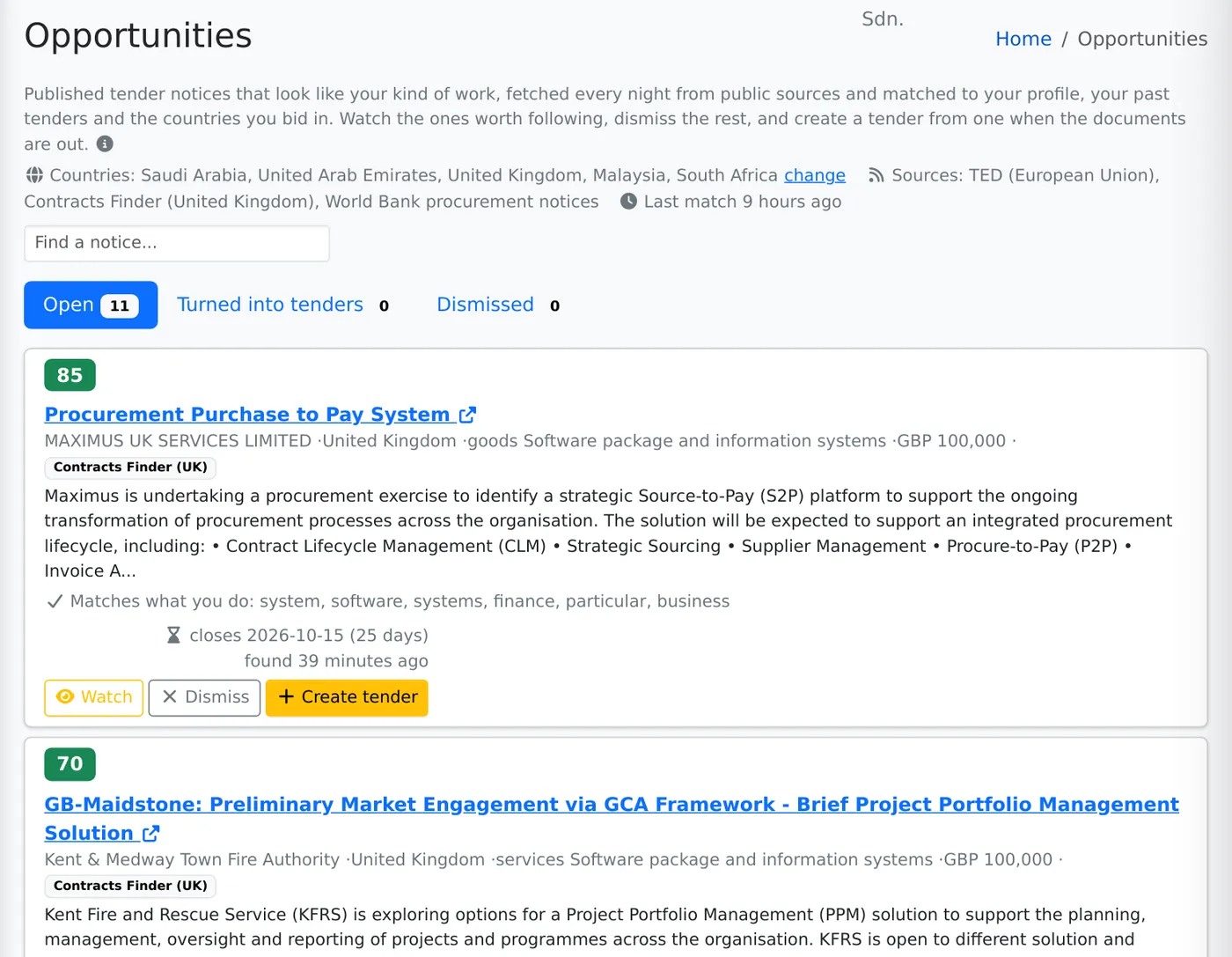
Find the tenders worth bidding for, in the countries you choose.
Tenderrizer reads published tender notices every night and matches them to what your company does and where you want to work. You start the day with a short list and the reason for each match, and one click turns a notice into a tender to respond to.
04 Time and quality
Faster than a bid team, and more careful than one at two in the morning.
The time saved is the obvious part: more than 90 percent of the preparation time on a typical tender. The less obvious part is that the pack is better: every requirement answered, every figure agreeing with every other, and nothing in it that nobody checked.
| The usual way | With Tenderrizer | |
|---|---|---|
| People and time | Three to five people for a week, nights and weekends near the deadline | One reviewer, an afternoon |
| Company facts | Retyped into fifty places, with a different version in each | Written once in the profile, quoted everywhere, checked across the set |
| The issuer's forms | Retyped into new files; the layout drifts | Filled in place, layout and wording untouched |
| Requirements | Checked from memory against a 300-page tender | Each one traced to its clause in a compliance matrix |
| Figures | Totals that disagree between schedules and the letter | One pricing basis; every schedule follows it |
| What nobody knew | Filled with something plausible | Marked NEEDS INPUT and listed for a person to answer |
| The next bid | Starts from a blank page | Starts from what the last one learned about that client |
The rules the engine works under
05 Around the bid
Everything else a bid team keeps in spreadsheets and inboxes.
The work before the documents and after the deadline, in the same place as the tender itself.
The Tenderrizer AI assistant
An AI assistant that knows your business, your tenders and the rules around them.
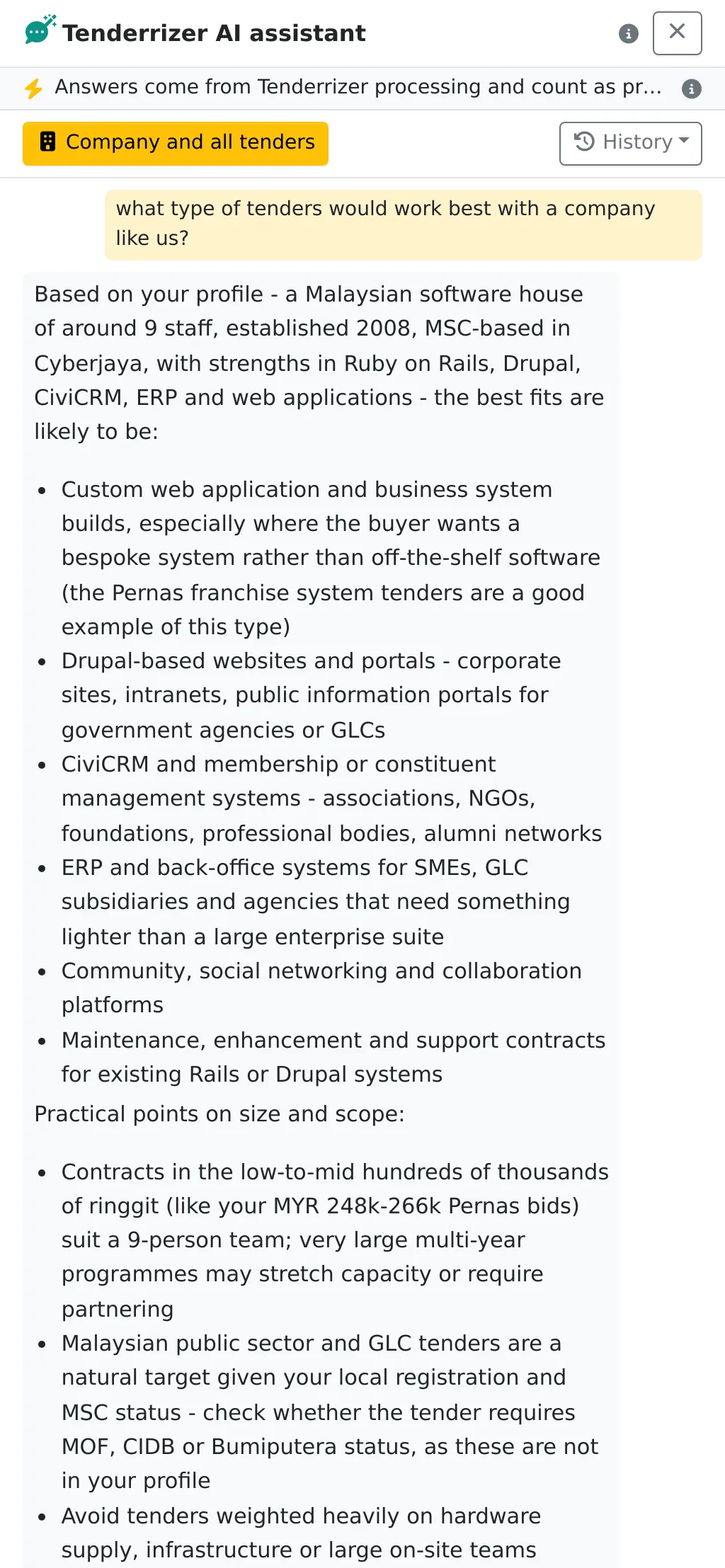
Ask it anything about a tender, your company's readiness, or the rules that apply to your sector and country: what a clause means, which registrations and licences an issuer will check, what is still missing, how the last bid for a client went. It answers from your company profile, your tenders and Tenderrizer's knowledge base of local procurement, tax and licensing rules, in any of nine languages.
Try asking
- Which registrations will the issuer check for this tender?
- What is still missing before we can submit?
- Is it common to bid for tenders in neighbouring countries?
- Which sectors are we best placed to bid in?
Guidance, not legal advice: for a binding opinion on a legal question, consult a lawyer.
Pricing workbench
The bill of quantities priced line by line from your own rate card, with overhead, contingency and margin, and a total that every document follows.
Addenda and issuer replies
An addendum or a clarification reply is read against the plan; the affected documents are flagged with what to do.
A team, a calendar and reminders
Roles for who may change what, a calendar of deadlines, and reminders before each one.
Nine languages, and your own systems
English, Bahasa Melayu, Arabic, Spanish, French, Russian, Chinese, Japanese and Korean; an API, webhooks and an MCP server so your own software and AI agents can work with it.
06 Trust
Your documents are confidential. They stay that way.
Tender documents carry prices, people and plans your competitors would like to see. The service is built around that.
07 Plans
A subscription for the platform. Processing units for the work.
The subscription covers your users, storage, support and an allowance of processing units each period. Further units are bought in packs when you need them, and you see what every tender used.
| Starter | Professional | Business | Enterprise | |
|---|---|---|---|---|
| For | Occasional bidders and a first tender | Regular bidders, one to three bids a month | Bid teams and multi-division companies | Large contractors and groups |
| Included units | 5,000 PU, about one full tender | 25,000 PU, four to six tenders | 100,000 PU | Agreed with you |
| Users | 2 | 5 | 15 | As many as you need |
| Storage | 256 MB | 384 MB | 640 MB | 1 GB or more |
| Extra units | Standard price | 15% off | 30% off | Agreed with you |
Prices are quoted in your currency when you request access. Plan contents are indicative until confirmed in your order.
One processing unit is the engine reading, reasoning or writing about 600 words.
Units for a full tender of about twenty documents, end to end, reading and planning included.
Units for reviewing, editing text, downloading, and for finding and ranking opportunities.
Next your next tender
Your next tender is already on someone's desk. Answer it this week.
Tell us what you bid for and where. We set up your company, and your first tender can start the same week.